Friday, February 22, 2013

Fusion Summer: Part II - Utah

All photos by Adam Goshorn unless otherwise noted.

After our four-day, self-supported run of Hells Canyon in Idaho, the second phase of our trip was going to be another self-support run, but this time we would be joined by my brother for a river on the easier end of the spectrum.  My brother had been learning to kayak over the past few summers and was very interested in doing his first self-supported river.  Wanting him to have a low-stress run for his first overnighter, early in the spring we had applied for permits for the Desolation Canyon section of the Green River in northern Utah and the Sand Island to Clay Hills section of the San Juan River in southern Utah.  We were hoping to win at least one of the two permits, but we ended up with neither.  However, a week before our departure for Idaho, my brother called me to say a cancelation opened up a launch on the San Juan and he had obtained the permit for us!  The launch date was little later than we had originally planned, but was workable.  The new launch date would result in Matt and I having almost a week between when John was scheduled to fly home from Salt Lake City and when we would meet my brother to run the San Juan.


From the take-out of Hells Canyon, Matt, John, and I drove due south, crossing into Utah and checking into a hotel in Salt Lake City. Making sure John was able to catch his flight home to Tennessee (the next morning) was the top of our agenda, but showers and a good night’s sleep was certainly a nice bonus. The next morning John took a shuttle to the airport while Matt and I took advantage of the hotel and slept in. After all, we had almost a week before our rendezvous to run the San Juan. We had discussed using this unanticipated extra time between self-support trips to swing through Colorado and do some creeking. However, the dismal snowpack left us with almost no options and we didn’t want to spend a bunch of gas money to paddle the one or two things that still had water.


Instead, we decided to try to take a more direct route towards the San Juan and see what we could find to amuse ourselves along to way. As we headed on our southern trajectory we ended we spotting whitewater right by the highway. From high above on the road we could see some boulder gardens and what looked like a runnable flow. Heading into the next town we sat outside a hotel to score some free internet and see what river we had seen from the road. Apparently there are multiple sections of Price River and the section that caught our eye was the middle section of Price River Canyon. The online description was rather vague, but it did give suggested access points for the best 8-mile section. It was late in the afternoon so we headed back up into Price River Canyon to camp at a BLM campground, planning to check out the run the following day. That night white ash settled on our tents and the surrounding area from the Price Canyon Fire located not far away.

Below: Smoke from the Price Canyon Fire.

The next morning we paddled the recommended 8-mile section and what we found was a fun run consisting of mostly class III-IV rapids with a few very continuous sections that might approach class IV+. It was actually quite fun, but unfortunately the river is sandwiched between the highway and the railroad. Almost every rock in the riverbed was a result of the construction of these two projects on either side, resulting in extremely sharp rock that simply shreds boats. Had the rocks been smooth I think we would have camped there for days and done laps on this fun little run. However, after a single run our boats looked terrible and neither of us was willing to abuse them again with a second lap.


While hitchhiking shuttle for Price River Canyon a nice family pulled over and rolled down their window. They had only stopped because they thought I was having car trouble (I was, after all, parked on the shoulder of a four-lane highway), but upon explaining that we were kayaking they agreed to give me a ride. They instructed their two children in the back seat to slide over and I climbed in next to them, immediately filling their car with the stench of unwashed paddling gear. I could smell myself, so I’m sure they were gagging, but they didn’t mention it as we rode up to the put-in. Along the way they told me about a great petroglyph site call Nine Mile Canyon, not far away. Matt and I decided to spend the following day checking it out.

Below: Matt hiking in Nine Mile Canyon


Below: Petroglyphs in Nine Mile Canyon

As we continued south towards our eventual goal of meeting my brother to paddle the San Juan River, we spent a few days around Moab, Utah checking out Canyonlands National Park and Arches National Park. The intense summer heat made it unbearable to do a lot of hiking, but neither of us had ever visited either park before and we made the best of it, checking out all the spots that had short hikes from the road.


Below: Canyonlands National Park


Below: Arches National Park

Below: Matt in Arches NP

Our last day in Moab we spent the afternoon at a laundry mat, giving our clothes a much needed freshening. The next morning we continued further south, eventually finding our way to Bluff, Utah and camping at the BLM campground at the put-in for the San Juan. We still had another day before my brother’s arrival, so we spent the next day making sure we could find the take-out and seeing the limited sites around Bluff. We also found great food at the Twin Rocks Café and I would highly recommend it to anyone in the area. We liked it so much we found ourselves eating there several times before and after our run of the San Juan.


Below: The Twin Rocks Café and Trading Post, photo by Vitaly Prikhodko


Below: Matt checking out the view along the shuttle route, photo by Vitaly Prikhodko

My brother flew from Knoxville Tennessee to Albuquerque New Mexico, rented a car, and then drove to Bluff to meet us. Doing so prevented us from having to pick him up at the airport and having the rental care meant we could drive our own shuttle and not pay for shuttle service. We spent the next day setting shuttle and also stopped to visit Natural Bridges National Monument (which was on the shuttle route on the way back to Bluff) and then ate another great dinner at the Twin Rocks Cafe. After dinner we checked out a large petroglyph panel near the BLM campground at the put-in and spent another night camping there as well.


Below: Vitaly looking back down at the crazy shuttle road we had just driven.


Below: Natural Bridges National Monument, photo by Vitaly Prikhodko

Yup, those little dots are people under one of the massive natural bridges.

Finally, after a week of killing time and slowly making our way to Bluff, the day of our scheduled launch arrived.  Matt and I were happy the waiting game was over and my brother was extra excited to launch on his first overnighter.  After our orientation with the river ranger, we launched mid morning and knocked out around 31 miles on the first day.  Even with the high mileage we put in, we still stopped for several long breaks to check out the Butler Wash Petroglyphs and the River House, an awesome cliff dwelling a couple hundred yards off the river.

Below: Petroglyphs at Butler Wash, photo by Vitaly Prikhodko

Below: Vitaly enjoying borrowing my Large Fusion.
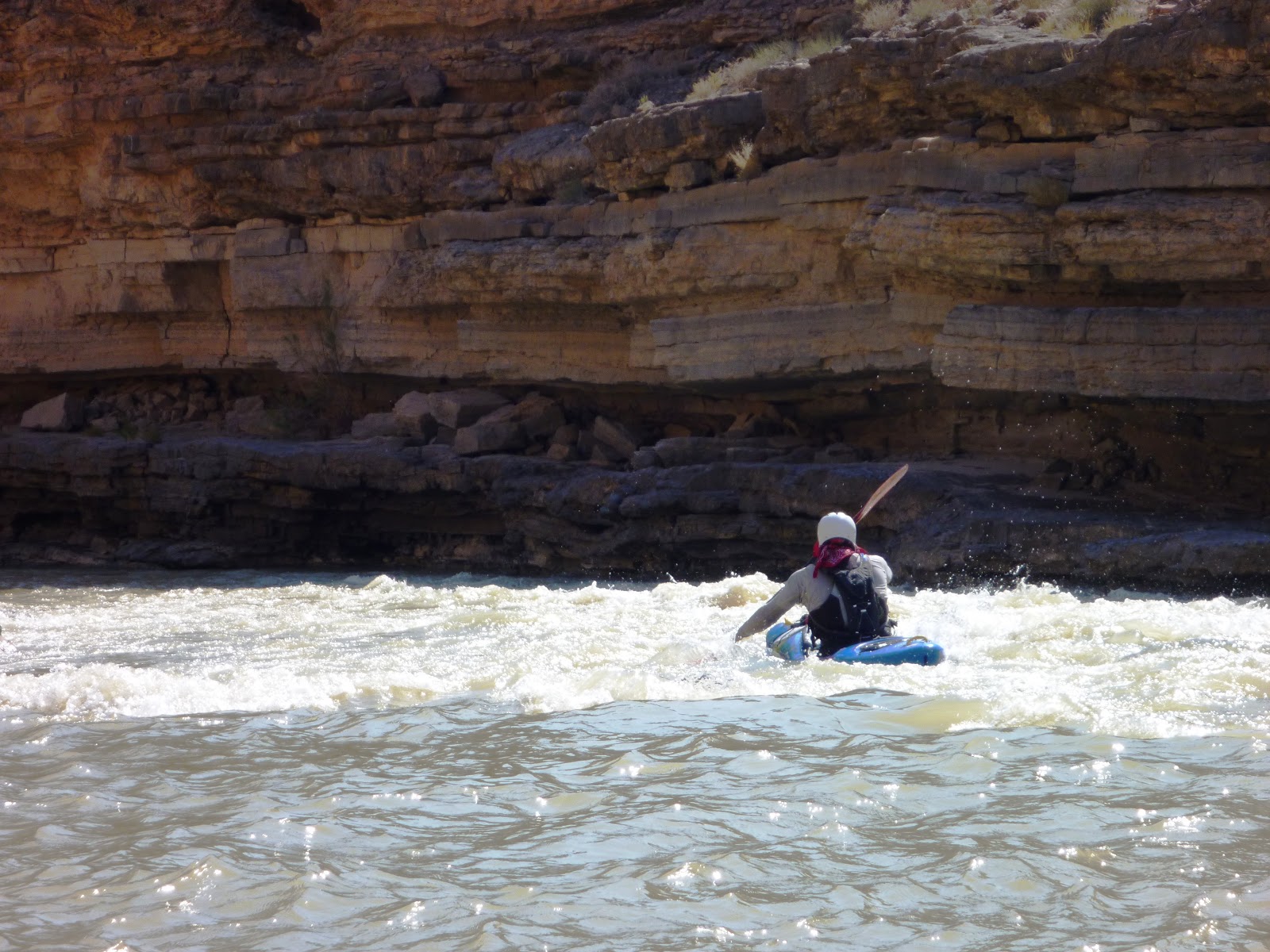
Below: The River House, photo by Vitaly Prikhodko

Below: Matt and I floating past the town of Mexican Hat’s namesake rock, photo by Vitaly Prikhodko

Our second day on the San Juan we were finally entering the deeper sections of its canyons and the scenery was superb.  We spotted multiple groups of Bighorn Sheep throughout the second day and also stopped to check out an old mining camp in the famous goosenecks section.  The bends in the river are so dramatic in the goosenecks that a bend in the river a mile long results in being only a hundred yards from where you started, if it is possible to cross the peninsula through the cliff.  The mining camp we visited was located on top of just such a bend, providing views off both sides.

Below: A large ram drinking from the San Jan River, photo by Vitaly Prikhodko

Below: Matt running Government Rapid, photo by Vitaly Prikhodko

Below: The view from my tent on the morning of Day 3
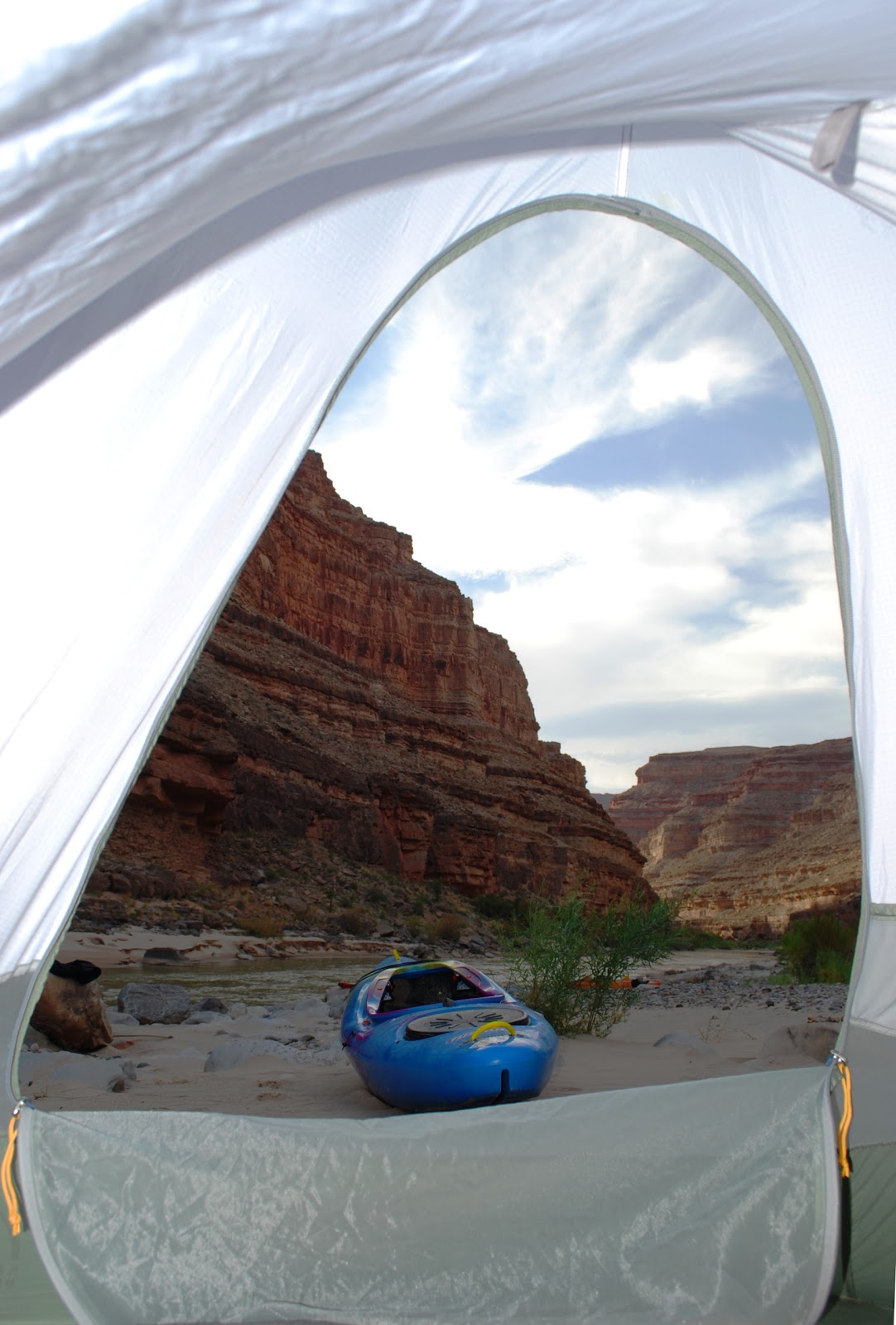
The total run from Sand Island to Clay Hills on the San Juan is approximately 83 miles.  After paddling over 30 miles a day on the first two days, we were left with a shorter section to paddle on the third and final day.  However, this section proved to be more challenging.  About 15 miles from the take-out at Clay Hills Crossing, the river begins to enter the backwaters of Lake Powell.  When it does, the water slows and begins to deposit much of its heavy silt load.  The result is massive sand bars that are often only a few inches under the surface across the whole river.  There are braided channels of deeper water, but following them is quite difficult.  We spent the last day struggling to stay in the deeper channels as much as possible, but time and time again we would be forced to climb out and drag our boats across the sand bars hidden just beneath the surface.  Then we would find another channel, stay in it as long as possible, and repeat the process again 15 minutes later.  We finally made it to the take-out, went back to the put-in to get the rental car, and drove into the night towards another destination that was a last minute addition to the agenda. 


Below: Pushing through the flats in the backwaters of Lake Powell, photo by Vitaly Prikhodko

We had originally planned to paddle the 83 miles down the San Juan in four days and three nights.  However, after having easily completed so many miles on the first day, we decided to knock it out in three days and use the extra day to visit Mesa Verde National Park in Colorado.  After taking off the San Juan, we drove all the way to Mesa Verde and found a campsite for the night.  The next day we spent the morning looking at the cliff dwellings and other ruins in Mesa Verde National Park before driving to Albuquerque to return the rental car.

Below: Mesa Verde National Park

Below: Mesa Verde National Park

From Albuquerque, the three of us rotated shifts driving and drove straight through to Knoxville in about 22 hours, dropped my brother at his house, and continued back home to Alabama.  It had been three weeks since Matt, John, and I had first hit the road and in that time we had driven through a dozen states, paddled hundreds of miles, visited four National Parks, and seen a huge swath of the country.  Once recovered from the intense drive home, we immediately began to discuss what are next adventure might be, the need for travel continuing to nag us every day we are at home.

Below: Vitaly, Matt, and I, photo by Vitaly Prikhodko

Until next time…

-Adam Goshorn

Below: A raft passing us at Butler Wash.

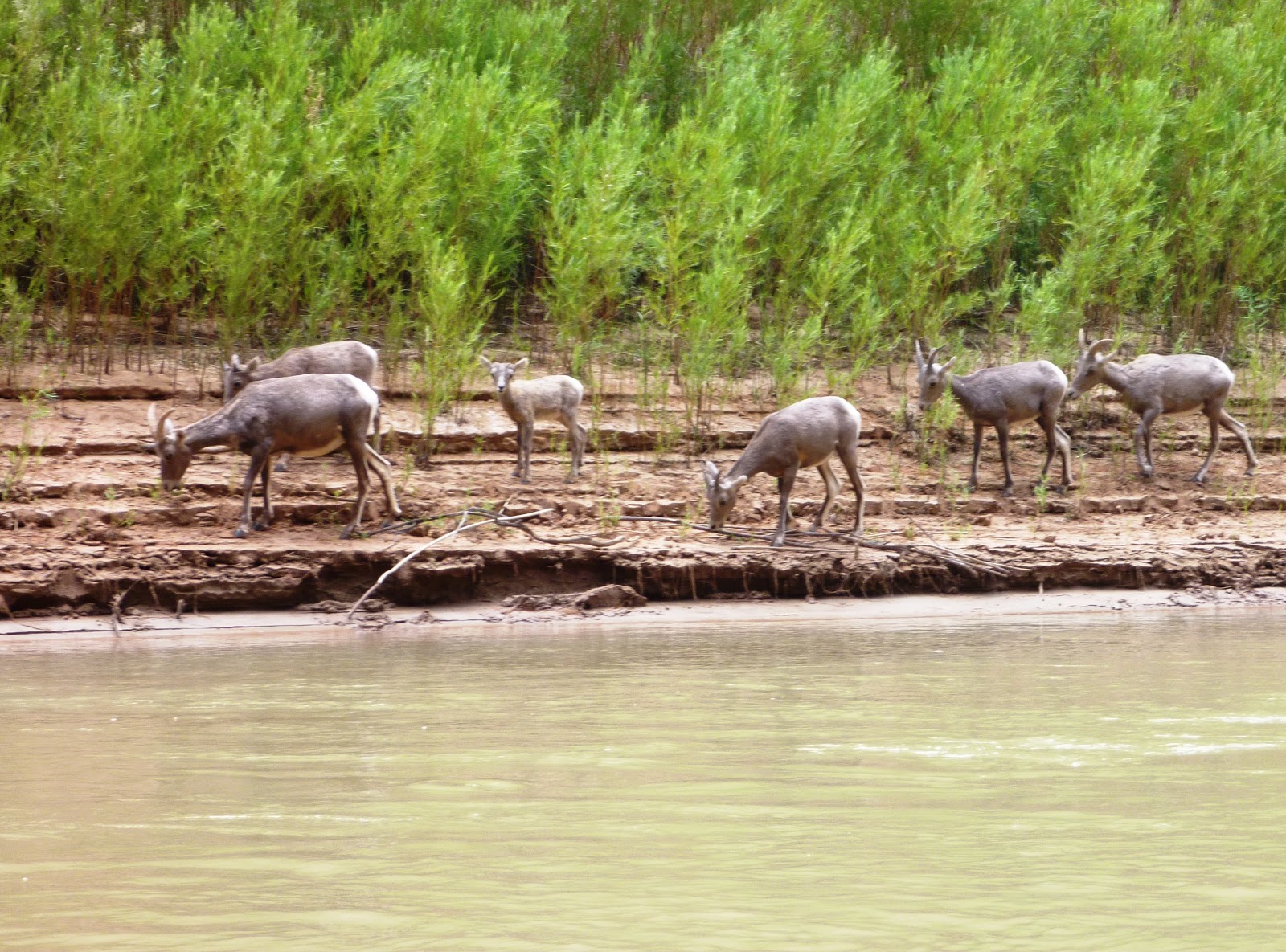
Below: One of many groups of Bighorn Sheep we spotted along the river, photo by Vitaly Prikhodko

Wednesday, November 21, 2012

Fusion Summer - Part I: Hells Canyon

Below: Adam Goshorn by John Kern
Early in the spring I really thought I had my summer plans all figured out.  A friend had won a permit for a June launch on the Middle Fork of the Salmon and I had accepted the invitation to join her for a 5-day, self-supported run.  I planned to extend my time out west by following the trip on the M.F.S. with another self-support run with my brother the following week.  My brother had been learning to kayak over the past few summers and was very interested in doing his first self-supported river.  Wanting him to have a low-stress trip for his first overnighter, we set our sites on obtaining permits for a couple different easy multi-day runs in Utah. 

Below:  Roadtripping by John Kern
Things seemed to have come together nicely, but then they fell apart.  A couple weeks before our departure, the permit holder for our Middle Fork of the Salmon trip had an irresolvable work conflict.  Without the permit holder, the trip was off.  In addition, neither of the permits my brother and I applied for in Utah had panned out and we realized we had just missed the two-week deadline for obtaining a permit for Cataract Canyon, our back-up plan.  Everyone involved had already scheduled their time off from work and some had even bought plane tickets.  So, we spent the next week scrambling to put together a plan for creeking trip in CO in the same timeframe.  However, last winter’s extremely light snowpack left outlook for quality creeking in Colorado looking pretty dismal. 

Below: Clouds by John Kern
A mere six days before our departure, our plan made another dramatic about-face.  I had been monitoring the Four-Rivers-Lottery website in hopes of a cancelation opening up a launch date for the Middle Fork of the Salmon.  No launches became available for the M.F.S., but one did pop up for Hells Canyon of the Snake River.  I didn’t know much about Hells Canyon, but after a couple minutes of internet research I decided to snatch it up while I had the chance!  Hells Canyon is not as much of a wilderness trip as the M.F.S., but four days of big water class III-IV sounded like a good time to me!  Only a couple hours later, my brother called me to say a cancelation opened up a launch on the San Juan for the following week and he quickly obtained that permit for us!  It was quite the rollercoaster of events with-in only a few hours and now that we knew exactly what we were going to do, we hurriedly made our final preparations.

Below: Sunset by Matt Jones
After making the long drive to Idaho, Matt, John, and I found ourselves to be somewhat of an object of fascination at the Hells Canyon put-in. People seemed a bit surprised and a little skeptical that there were only three of us and that we were self-contained in our kayaks. It is a skepticism I have grown accustom to after self-supporting other traditionally raft-supported runs, including the Grand Canyon in January of 2011. As raft groups sorted their mountains upon mountains of gear and organized their crowds of participants, I was quite happy with our small group and the simplicity of our set-up. After receiving our gear check by the ranger, we set off downstream, planning to cover the 78 miles to Heller Bar over the next four days.

Below: Adam Goshorn by John Kern
Despite the name, Hells Canyon is not an especially difficult river.  The rapids are large, but not overly complicated and avoiding huge holes is the main concern.  The biggest rapids come early in the run and not wanting to blaze all the best ones on the first day, our plan was to paddle down past the first big rapid (Wild Sheep) and camp above the second big rapid (Granite).  Wild Sheep was big, certainly on par with the biggest of the rapids in the Grand Canyon.  We almost ran it blind because floating on 29,000 CFS we covered the first seven miles so quickly we almost didn’t realize we were already arriving at Wild Sheep.  We paddled very close to entering the rapid before realizing the steepening river and roar of the rapid was much larger than anything we had encountered up to that point.  As we eddied out on river left, the well worn scouting trail confirmed for us that we must be at one of the biggest rapids on the run.

Below: John Kern by Adam Goshorn
We scouted Wild Sheep from a trail high on river left.  We all agreed on the preferred line and ran the rapid one by one, snaking our way between the holes and crossing the boiling eddy line to exit the current at the bottom.  Everything went well at Wild Sheep and after a few more miles we camped just after Granite Creek entered on river right and a little ways upstream of the rapid of the same name.  Granite was the second biggest rapid on the run and would be our after-breakfast treat the following morning.  We set up camp in the middle of the afternoon and spent the rest of the day relaxing, fishing, and enjoying the awesome landscape around us.

Below: Matt Jones by Adam Goshorn
Breaking camp early on day two, we packed our boats and paddled a little ways towards Granite before getting out on the right to scout.  Due to the size and length of the rapid, scouting required exiting the river almost a quarter-mile upstream and hike down to a large rock about twenty feet above the main part of the rapid.  Matt and John were hanging out on the rock, scouting the feature known as the Green Room.  I hung back on the trail to take some photos of some pictographs on a cliff above the rapid.  As I approached the scout rock, I also paused to shoot a few photos of John and Matt scouting.  I finally joined them and just as I started scout, John’s boat suddenly appeared upstream, unmanned and heading right for the meat of Granite! 

Below: Matt Jones by Adam Goshorn
We knew that when the dam upstream started generating power we would get a big pulse of extra water and we had all pulled our boats up on shore what seemed like a reasonable amount, but obviously it wasn’t enough.  An instant after we spotted John’s boat, it flipped as it hit the first huge wave as we took off running upstream in a full sprint.  I was running with my video camera in one hand and my still camera in the other.  I tried to keep up with Matt, but he quickly expanded his lead.  When I caught up to him he was shoving my boat back onto shore and he told me later that it was floating in the eddy when he arrived at the put-in.  Matt and I leaped into our boats and took off downstream toward Granite.  I hadn’t really scouted the rapid thoroughly, but the left side looked easiest and Matt went first with me following him; paddling full speed into the second largest rapid on the run. 

Below: Adam Goshorn by John Kern
We both emerged from Granite upright and continued in a full sprint for the next couple miles until we finally caught up to John’s boat floating in an eddy.  We towed it to shore and despite having run several large rapids unmanned, the gear inside the hatch was still nice and dry.  Unfortunately, there was no sign of John’s helmet or the Go Pro camera that was mounted on it.  He had left the helmet in the seat of the boat when we went to scout and it was nowhere to be found.  As we had shoved off to run Granite, a rafting trip was just pulling over to scout.  Luckily, John was able to catch a ride with them.  Eventually they caught up to us and had a helmet they were willing to loan John so he could continue.  Disappointed to have not found the helmet, but happy to have found the boat, we continued downstream scanning the shoreline the whole way hoping to find the helmet, camera, or both. 

Below: John Kern and Adam Goshorn by Matt Jones
About twenty miles later we pulled over to check out an old ranch on river right.  After exploring the ranch for a while we were back at the water and about to continue downstream when a boat pulled up and one of the occupants asked, “you guys missing a helmet?”  Amazingly enough, the boat’s occupants had found John’s helmet, with the Go Pro camera still attached, in a eddy just below Granite.  They had been rushing downstream all day trying to catch up to us to return it.  On top of their good deed in returning the helmet and camera they also insisted on sharing their generous supply of cold beer, solidifying their good karma for years to come!

Below: Matt Jones and Adam Goshorn by John Kern
After the excitement of the second day, the third and forth day went by without a hitch.  We continued to enjoy the superb scenery, camping, and fishing.  As we continued downstream, we passed the confluences of the Rondo River and then the Salmon River.  Combined, the flow that these two rivers added basically doubled the total volume and we found ourselves floating on over 50,000 CFS by the time we approached the take-out.  As we rounded a bend on day four, still easily a half mile or more from the take-out, we could see my truck being dropped off by the shuttle service.  It was perfect timing.  We were ahead of schedule and luckily our shuttle drivers were as well and we arrived at the take-out just a few minutes after them. 

Below: Adam Goshorn by John Kern
It has been said that a trip is not a real adventure until something goes wrong. I’m just glad in this case that our little adventure ended with all the people and gear that we started with. A big thank you goes out to the group that found and returned John’s helmet. An equally big thank you is also due to the group that gave John a ride on their raft and loaned a helmet to a stranger in the middle of no where. It is a special thing that the river community shares and it is great to feel the love of the wider river community even when far from home.

Until Next Time…

Adam Goshorn

Below: Matt Jones, John Kern, and Adam Goshorn after Hells Canyon.

Monday, October 8, 2012

Remembering Jeff West

In the early morning hours of Wednesday September 12th, while I was still asleep, I heard the buzz of a text message reaching my phone which was sitting on the night stand beside my bed.  Assuming it was something unimportant, I ignored it and started to drift back to sleep.  Suddenly the buzzing of another text, then a third and a forth...  I grabbed my phone to find that several friends were had sent me the terrible news of Jeff West's death on the Stikine.  Over the next few hours and days the news of Jeff's death sent shock waves through the southeast paddling community.  The feelings that week brought up memories of others and I couldn't help being reminded of the death of Daniel DeLaVergne how it too rocked our community in a similarly huge way.

When I relocated from Virginia almost a decade ago, one of the main factors in my decision was that I wanted to be closer to a reliable, dam-released river so that I could continue to feed my paddling obsession year-round. I ended up settling in Mentone Alabama about an hour and a half from the Ocoee River in Tennessee. It wasn’t long before I met one of the Ocoee’s most famous sons, Jeff West. One day, a mutual friend pointed out Jeff while he was playing in Hell Hole in his Perception Lucid (a boat that never looked quite as good with anyone else paddling it!). Later we were introduced at the take-out and Jeff’s smile and easygoing attitude made an immediate impression on me and our paths crossed frequently over the decade that followed.


Over the years I can’t think of a single time when Jeff and I actually made plans to paddle together. We ended up on the river together plenty of times as groups of mutual friends would merge or as we would stop to talk and catch up with each other. Jeff was always willing to take the time to talk and we would trade stories about whatever paddling adventures we had each had recently. I don’t think Jeff realized the inspiration that I drew from those talks or how much I looked up to him in many ways. Perhaps he did realize it, but was so comfortable in his role inspiring others that he never acknowledged it or used it to boost his own ego.

Jeff was atypical combination of someone with extraordinary paddling talent who devoted the majority of his days on the river to instruction. In any given year, I would guess the ratio of days Jeff spent teaching others verses paddling for his own recreation was easily 5:1, probably more. It’s a rare combination indeed considering how capable he was of running hard whitewater and how much he loved doing so. I don’t think it’s a secret that top-level paddlers often have top-level egos to go with it. Running difficult whitewater requires high levels of self confidence. The harder the moves and the greater the consequences the more confidence required in yourself and your abilities. Too often as top-level paddler’s confidence grows, so do their egos, but not with Jeff. I don’t know of anyone as capable who was so uninterested in pursuing external validation.

When he wasn’t instructing, Jeff was interested in pushing his own limits, not one-upping others, and not shopping for sponsors. It was just as true when he was doing attainments on the Ocoee as it was when he was seeing how many laps he could do on any number of class V creeks. Jeff’s interest seemed mainly in pushing himself and measuring himself against his previous personal best.  I imagine it was that interest in pushing himself and testing his own limits that led him to attempt the Stikine solo.  Jeff had run the Stikine previously (including a descent last year in an amazing 7 hours), I can imagine that for him, a solo descent was just the next step in pushing himself.  A vision quest to combine his years of training and achievements.  Had he come away unscathed we would all have been impressed, but would not have been a surprise.  Instead we do not know exactly what happened.  The potential for things to go wrong in such an environment is high and small problems can multiply quickly and lead to disaster.  Somehow it would be slightly easier to accept his death if I knew he had broken a paddle or backband, or perhaps his skirt imploded.  I like to think that it was gear failure and not just the difficulty and dangers of the whitewater paddling.  Maybe that thought is more comforting to me because if it was not gear failure than the dangers of whitewater paddling can take any of my friends or me, and that isn't something any of us like to think about.

In the early days of his paddling instruction business (Ace), Jeff was working other jobs to make ends meet. As the business grew over time he was able to spend more and more of the year on the river and support himself doing so. I’m sure he knew the path to monetary wealth was not through paddling instruction. His interest and motivation was to introduce others to the sport that he loved so much. Jeff was a paddling evangelist, preaching the virtues of the river life to anyone who would listen. Sure, he had goals for his business, but he also knew he would never be monetarily rich from his chosen career path. However, for those of us who measure our wealth in days on the river, nights by the campfire, and laughter shared with friends… Jeff was one of the richest men I’ve known. We should all hope to have a life as rich.  Rest in peace Jeff, you will be missed.

Until Next Time...
-adam

kayak session

Wednesday, May 2, 2012

Pyranha Shiva Review!

Photo below by Shannon MacMichael

When I first heard Robert Peerson was joining the design team at Pyranha I immediately texted a good friend of mine who paddles for Wave Sport to tell him the news.  All he said in reply was… “Shit”.  It is no secret that Robert Peerson is a talented designer and his playboats have been especially well received around the globe.  Everyone at Pyranha was clearly excited for him to come on-board and I was too.  I had tried out most of Peerson’s playboat designs over the years and liked them a lot.  However, I have to admit that when I heard that his first design for Pyranha would be a creekboat, I had a few reservations.  Not because I had doubts about his ability to design a creeker, but because I’m a big guy and the last creekboat he designed simply wasn’t that big.  Even the largest size of his last creekboat design was just not big enough to be a real option for big guys like me.  However, when the stats for the Large Shiva were released, my apprehension turned to pure excitement!  Not only was the Large Shiva much larger than Peerson’s previous creekboat design, it was the highest volume creekboat Pyranha has ever made… I was beyond pumped!


Boat Stats: Large Shiva
Length: 8’8”
Width: 27”
Volume: 92 gal
Weight: 55 lbs

My Stats:
Height: 6’1”
Weight: 275 lbs.
Inseam: 30”
Feet: size 12

When reading a review of a boat or other gear, it is as important to know some background on the reviewer as it is to know their physical stats or anything else. Knowing a little of their background allows readers to take the review in context and see their opinion for what it is. I started paddling canoes with my dad in the 1980s, got my first whitewater specific canoe in the mid 1990s, and then moved on to kayaking in 2000. Having entered kayaking after the introduction of edges and flatter hulls, the majority of the boats that I have owned have had semi-planing hulls and I have had a well developed bias towards boats with a harder edge. However, I do love to try out different boats and try to understand their design and performance differences. Everything is a trade-off and I’ve grown to appreciate different design traits in different circumstances. Since the release of the Shiva a lot of people had been asking my opinion of the Pyranha’s latest creek machine, so when I got one at the end of January, I was committed to spending some quality time in it to be able to evaluate it accurately and develop an informed opinion.

Photos below by John Kern


At the time of this writing I have paddling the large Shiva 2-3 days a week since the end of January 2012. I’ve had a chance to paddle it on a variety of runs ranging from steep, low volume creeks to higher volume rivers, including Tellico River (TN), Cheoah River (NC), Tallulah River (GA) Town Creek (AL), Short Creek (AL), Johnnies Creek (AL), and the West Fork of the Little River (AL).  In addition to those runs, I’ve spend the most time on Alabama’s Little River Canyon (my local favorite) at levels from 200 CFS to 1000 CFS. Little River Canyon's character varies greatly depending on the water level. At lower levels it is a super-technical creek run while at higher levels the rapids become pushy and can develop stomping-big holes. A wide range of water levels and the different characteristics provided by each provided a great opportunity to test the Shiva out in a variety of situations.

Photo below by Jay Howard


When the stats for the Large Shiva were released, the size alone grabbed my attention and before I even had the Shiva in the water, one of the first things I noticed was the large amount of volume in the stern of the boat. Once I had it on the water, that extra volume kept the stern riding high and dry and unaffected by tricky cross currents. Overall it floats me higher than most creekers and I have to admit that alone is a big plus for the Shiva in my book. Another thing I noticed in my first few days in the Shiva was that I kept feeling like my bow was a little low. At first I had left the seat in the factory position (centered), but once I moved the seat back, I immediately felt at home in the Shiva. From that point forward I found myself become more at-ease in all different situations on the river and my confidence (which had been battered some in recent months) seemed to return more and more each day I was on the water.

Photos below by Matt Jones

Pros
Other than playing around, doing enders, I didn’t even flip over for the first couple months I owned the Shiva. It is quite forgiving and has awesome secondary stability. The result is that those deep braces that often precede flipping are instead able to bring it back upright! When rolling is necessary, the Shiva it does so quite easily, a feature to be appreciated by beginners and experts alike. Personally I’ve found that that I can successfully hand-roll the Shiva much more often than I ever could in the Everest. The Shiva’s overall speed doesn’t seem faster to me than the Everest, but its ability for quick acceleration allows for more confidence in boat scouting. More and more lately I find myself floating into the top of a rapid, waiting until I can pick out my line before making the move, confident in the ability to accelerate quickly enough to make the move. I’ve only had a chance to run a few waterfalls in Shiva so far, but those that I have resulted in quick, controlled resurfacing, another great feature. Overall, the Shiva is simply very forgiving and as a nice bonus the flat cockpit design creates a very dry fit for skirts. I’ve been using the XL deck IR Klingon Empire skirt on my Shiva and commonly finishing runs with almost no water in my boat.

Photo below by Shannon MacMichael


Cons
The only cons for the Shiva are the same as every displacement hull creeker. Simply put, a round hull is going to get pushed around more in high volume runs and will not provide the snappy handling of boats with a harder edge, like the Everest/Burn/etc. However, the slight edges on the stern of the boat do seem to make the Shiva hold a line better than most displacement hull creekers and seem to help with driving where you want to go in pushy water. In other words, while it does display some of the same design trade-offs as other displacement hull creekers, the Shiva’s design minimizes them while keeping the positive aspects and advantages of the displacement hull design.

Photo below by Jay Howard

Conclusions
For the first time since the release of the Everest in 2007, a new boat has won me over. Since getting the Shiva, my Everest has not seen the river and sits lonely and dry in my basement. I plan to keep the Everest around for pushy, high volume river running and creeking, but the Shiva is my new go-to boat for the low-volume steep runs that make up most of creeks in the southeastern United States. While there are many quality creekboats in today’s market, there are none more competent than the Shiva. The Shiva’s capability on steep creeks is incredible and confidence inspiring. A few quick strokes bring it up to speed, it boofs like a butterfly, and it blows though holes with a vengeance! It rolls with ease and its forgiving nature takes care of my wrecked body and degenerated joints. After a lifetime of paddling and over a decade of creeking, it is exactly the kind of boat I need to take care of me when it counts and give me the confidence to continue to paddle the runs I love.

Photos below by John Kern

Until Next Time…

Adam Goshorn

Photo below by Matt Jones


kayak session